.jpg)
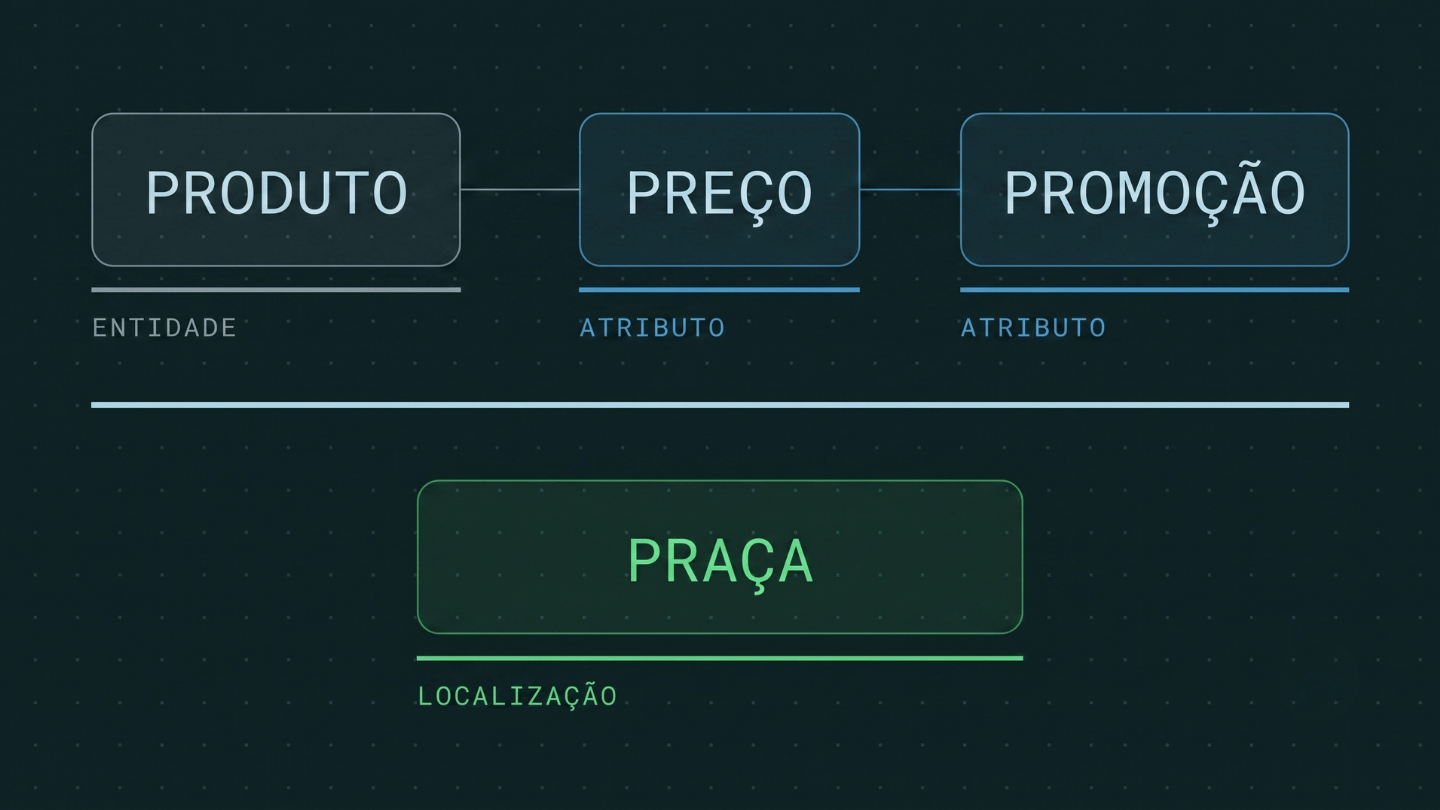
Geomarketing is not just a cross between geography and marketing, but a field essentially shaped by economics.
Geography provides the stage — the layout of spaces, population flows, infrastructure, but it's the economy that dictates the rules of the game: where are the actors, or consumers, what is their purchasing power, how competition affects the spatial distribution of businesses, and how logistics costs impact business decisions.
If we think about the very origin of the word “marketing” (market in action), it is clear that it is not enough to know Where customers are.
The fundamental thing is to understand like and Why they act as they do, which requires an in-depth economic reading.
Geography + Economics = Geomarketing
Spatial economics, developed by theorists such as Walter Christaller and updated by Paul Krugman, teaches us that markets are not randomly distributed in space, but follow structural patterns influenced by factors such as income, infrastructure, and transportation costs.
Geomarketing is based precisely on this logic, using economic data to understand how the demand for products and services varies in different locations.
A supermarket doesn't choose a neighborhood just because there are a lot of people there, it chooses because there's a Viable consumer market, which takes into account per capita income, buying behavior, and local competition.
The process of forming new geographies
Imagine that the territory is a large board, what would be the rules of this game?
This is a work developed by Paul Claval and other economists from the New Economic Geography.
They study the dynamics by which spatial strategies are constantly reorganized.
A bit of history
In the beginning, economic geography mapped production and trade zones, and this descriptive approach dominated until the mid-20th century, with maps showing merchandise flows, production chains, and industrial zones.
Despite its usefulness, it ignored the underlying economic dynamics.
It was like trying to understand a game of chess just by looking at the position of the pieces, without considering the rules that govern their movements.
In the 1950s and 1960s, economic geography underwent its first major evolution with Spatial Economy, authors such as Von Thünen and Alfred Weber, Christaller and Lösch were some of the masters of this board, proposing mathematical and spatial models to explain the logic of the location of economic activities.
David Harvey, one of the most influential geographers of this period, introduced the idea of Spatial Fix — the need for capitalism to reconfigure its spatial bases periodically to continue growing.
Paul Krugman would later take this approach further, explaining how international trade and domestic markets influence the location of production and industries.
The concept of center and periphery
This theory was developed to explain the inequalities between rich and poor places.
Its logic is simple, we have two types of places:
- In the “center” (rich producers), we find highly industrialized product markets, with the capacity for technological innovation, advanced infrastructure, and robust consumer markets.
- In the “periphery” (poor consumers), markets with economies dependent on primary activities, with low value aggregation and little capacity for innovation.
Some sell bananas, others sell smartphones.
The advantage of the center over the periphery was called Agglomeration Economy.
In which the concentration of industries in certain places generates competitive advantages that make it difficult for other regions to break this cycle.
Imagine a large technological hub, such as Florianópolis: the companies that are located there benefit from innovation networks, qualified labor and existing infrastructure.
This sum of synergistic operations attracts even more businesses, who seek this advantage and end up reinforcing it.
However, this logic can be reversed, some regions are able to break the cycle of dependence and develop their own industries, as occurred in the Digital Port of Recife, a degraded region that, starting in the 2000s, began to receive investments to become a technological hub.
These are examples where “new economic geographies” emerge not only because of market factors, but because of political and strategic decisions.
Conclusion
Ultimately, no there is a single economic geography, but a mosaic of geographies that overlap and interact.
The formation of new economic geographies emerges from the interaction between technology, politics, culture, and innovation ecosystems.
Today, economic geographies are being redesigned once again.
Global supply chains are being restructured because of geopolitical crises, digitalization is creating new centers of economic power, and environmental challenges are forcing the economy to rethink its growth model.
The board is always in motion, understanding this complex dance is the challenge of economic geography.